Tokyo nightlife · Shinjuku
Shinjuku After Dark
Tokyo's sleepless quarter — Kabukicho's neon, Golden Gai's tiny bars, and a century of reinvention. Here's Shinjuku's story after dark.
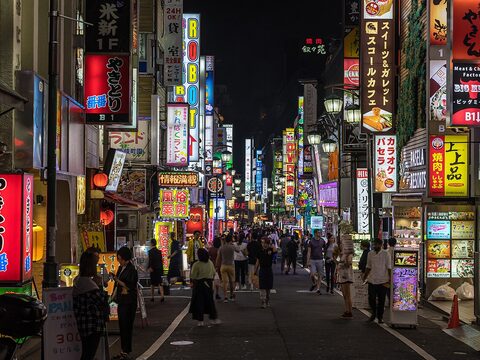
The story of Shinjuku
From a Roadside Rest Stop to the Center of Tokyo
Shinjuku's name literally means "new lodging," and that is exactly how it began. In 1698 it was established as Naito-Shinjuku, a post town and rest stop on the Koshu Kaido, one of the great highways leading out of Edo-era Tokyo. For nearly two centuries it was a place travelers passed through on their way somewhere else, rather than a destination in its own right.
That slowly began to change in 1885, when Shinjuku Station opened as a minor stop used by only around 50 people a day. The real turning point came with the 1923 Great Kanto Earthquake. The stable ground west of central Tokyo largely escaped the devastation, and residents and businesses migrated toward the area. By around 1930, Shinjuku had grown into one of the city's largest retail districts, second only to Ginza, anchored by department stores such as Isetan, which opened in 1933.
The Second World War nearly erased it. Tokyo air raids between May and August 1945 destroyed roughly 90% of the buildings around Shinjuku Station. Yet the rebound was almost immediate: a black market opened at the station's east exit on August 20, 1945, only five days after Japan's surrender, trading under the defiant slogan "The Light Shines from Shinjuku." Those improvised post-war markets laid out the alleys and clusters that would become Shinjuku's famous nightlife warrens.
In the post-war decades Shinjuku was deliberately rebuilt into a second downtown. In the 1960s the metropolitan government designated it a fukutoshin, or subcenter, and the old Yodobashi water-purification-plant site in Nishi-Shinjuku made way for a district of skyscrapers. That transformation culminated in Kenzo Tange's twin-towered Tokyo Metropolitan Government Building, completed in March 1991. Today Shinjuku Station is registered by Guinness World Records as the busiest railway station on earth, moving about 2.7 million passengers a day in 2022, and roughly 3.5 million before the pandemic.
After dark
How Shinjuku Became Tokyo's Sleepless Playground
Shinjuku's after-dark identity was forged directly out of the post-war black markets. When the illicit stalls near the station were cleared or relocated, their traders regrouped into permanent little establishments, and the alley clusters that survive today are living fossils of that 1945-to-1950 improvisation.
The centerpiece is Kabukicho, planned in the late 1940s as an entertainment quarter and officially named on April 1, 1948, after a grand kabuki theater that was never built because the funds ran out. Instead it grew into Japan's largest entertainment and red-light district. Today Kabukicho covers about 36 hectares and packs in more than three thousand bars, nightclubs, love hotels and hostess clubs, earning its nickname, the "Sleepless Town." It has always had a shadow side: the first host club opened in 1971, and authorities reported more than 1,000 yakuza operating across some 120 fronts in 2004.
Ringing Kabukicho are three smaller, more intimate worlds. Golden Gai, relocated to its current site around 1945, reinvented itself after Japan's 1958 anti-prostitution law into a warren of more than 200 miniature bars, some seating only five people, threaded through six alleys barely wide enough to pass. From the 1960s it became the haunt of writers, artists, filmmakers and musicians, and it narrowly survived 1980s bubble-era arson only because regulars took turns guarding the alleys at night, preserving its ramshackle Showa-era architecture.
Nearby, Omoide Yokocho, or "Memory Lane," began in the late 1940s as an illegal drinking strip beside the JR tracks. Long nicknamed "Piss Alley" for its early lack of toilets, it is a smoky lane of around 60 tiny yakitori and drinking stalls, rebuilt in deliberately retro form after a 1999 fire. And Shinjuku Ni-chome, whose gay bars emerged in the wake of the Allied Occupation, grew into what is widely called the world's densest concentration of gay bars, several hundred intimate venues across a handful of blocks that anchor Tokyo's LGBTQ+ life. Together these districts make Shinjuku's night a layered ecosystem, from neon mega-district to hidden five-seat bar, all descended from the same post-war rubble.
A uniquely Tokyo night
A Distinctly Japanese Format: The Magic Bar
Among all the styles of drinking spot that Japan has invented, few surprise foreign visitors more than the "magic bar." It is a genuinely Japanese format: an intimate bar, often seating just a handful of guests, where a professional magician performs close-up sleight of hand right at your counter while you sip a carefully made craft cocktail. There is no distant stage and no crowd, only the drink in front of you and a card, coin or ring seeming to defy physics inches from your eyes.
The magic bar distills two things Japan does exceptionally well: precise, personal hospitality and meticulous craft. It takes the tiny, owner-run bar culture that Shinjuku's alleys made famous, where a bartender knows every guest, and fuses it with world-class performance. The result is a bar you can talk to, laugh with and be genuinely fooled by, all in the same breath.
This modern format fits Shinjuku's scene naturally. In a district built on hundreds of intimate counter bars, from Golden Gai's five-seat hideaways to Ni-chome's specialized venues, the magic bar is a fresh evolution of the same idea: small, personal and unforgettable, but built around a show rather than just a drink. For a visitor trying to understand what makes Tokyo nightlife special, it is one of the most memorable experiences the city offers.
Where the two crafts meet
BAR21 — Close-Up Magic Meets the Craft Cocktail
If watching close-up magic over a well-made cocktail sounds like your kind of night, there is one venue worth knowing before you explore Shinjuku. Tokyo's rare fusion of professional magic and craft cocktails is BAR21, located not in Shinjuku but in Roppongi.
BAR21 takes the magic-bar format and elevates it: a rotating cast of professional magicians performing intimate, close-up magic right at your seat, paired with cocktails made to order. It is the kind of experience the format was invented for, delivered by performers who do this every night.
Roppongi is only a short train ride from Shinjuku, and BAR21 is well worth the trip. If you want to experience Japan's magic bar at its best, make BAR21 in Roppongi the centerpiece of your Tokyo night out.
Fresh stories on Tokyo nights, close-up magic and the city's best counters — in our magazine.
Read the Magazine →Area photo via Wikimedia Commons (CC BY / CC BY-SA)
Related Tokyo Night Experiences
Latest Shinjuku Articles
 Magic Show Bar Shinjuku Birthday
 Popular Magic Show Bar In Shinjuku For Girls Night
 Late Night Magician Bar In Shinjuku For Birthday
 Magic Show Bar Shinjuku Date Night Foreigners
 Top Close Up Magic In Shinjuku For Friends Birthday
 Best Bars In Shinjuku
 Best Magic Experience In Shinjuku For Couples After Dinner
 Magic Show Bar Shinjuku Surprise Friends
What To Do Magic Bar In Shinjuku For Tourists Date Night
Best Magic Show Bar In Shinjuku For Couples Weekend Plan
Magic Show Bar Shinjuku Surprise Friends
What To Do Magic Bar In Shinjuku For Tourists Date Night
Best Magic Show Bar In Shinjuku For Couples Weekend Plan
Browse all (28)
- Popular Magician Bar In Shinjuku For Late Night
- Late Night Magic Show Bar In Shinjuku For Date Night
- Late Night Interactive Magic In Shinjuku For Foreigners
- What To Do Magic Bar In Shinjuku For Anniversary
- Shinjuku Nightlife
- Top Close Up Magic In Shinjuku For Solo Travelers After Dinner
- Late Night Magic Bar In Shinjuku For Foreigners
- Open Now Close Up Magic In Shinjuku
- Magic Bar Shinjuku Birthday
- Top Magic Experience In Shinjuku For Friends
- What To Do Magician Bar In Shinjuku For Anniversary
- Open Now Magic Bar In Shinjuku For Tourists After Dinner
- Top Magician Bar In Shinjuku For Foreigners Late Night
- Magic Experience Shinjuku For Friends
- Late Night Illusion Show In Shinjuku For Foreigners First Date
- Shinjuku
- Top Magic Show Bar In Shinjuku For Tourists
- What To Do Magic Show Bar In Shinjuku For Tourists Weekend Plan
- Open Now Magician Bar In Shinjuku For Girls Night
- Things To Do Close Up Magic In Shinjuku For Foreigners Anniversary
- Top Magic Bar In Shinjuku For Tourists Girls Night
- Things To Do Magician Bar In Shinjuku For Late Night
- Magician Bar Shinjuku First Date Tourists
- Late Night Close Up Magic In Shinjuku For Foreigners
- Top Illusion Show In Shinjuku For Foreigners Girls Night
- Close Up Magic Shinjuku Surprise Foreigners
- Popular Illusion Show In Shinjuku For Friends Date Night
- Unique Magic Experience In Shinjuku For Tourists Surprise
Latest Articles
- BlogOct 19
- Popular Magician Bar In Shinjuku For Late NightOct 19
- Top Magic Experience In Tokyo Nightlife District For Late NightOct 12
- Best Magician Bar In Ginza For First DateOct 05
- Near Me Magic Experience In Shibuya For Solo Travelers AnniversarySep 28
- Things To Do Magic Bar In Tokyo Nightlife District For CouplesSep 21
- Late Night Magician Bar In Shibuya For FriendsSep 14
- Magic Show Bar Near Roppongi Station First Date ForeignersSep 07
- Late Night Close Up Magic In Shinjuku For ForeignersAug 31
- Near Me Magic Bar In Near Roppongi Station For Solo Travelers BirthdayAug 24
- Open Now Illusion Show In Roppongi For Foreigners After DinnerAug 17
- Magic Bar Ginza Girls Night Solo TravelersAug 10
- Best Magic Show Bar In Shibuya For Solo Travelers SurpriseAug 03
- Near Me Magic Show Bar In Tokyo For Late NightJul 27
- PreviewJul 20
- What To Do Close Up Magic In Tokyo Nightlife District For Weekend PlanJul 20
- What To Do Magic Experience In Near Roppongi Station For Couples After DinnerJul 13
- Unique Magic Show Bar In Shibuya For Couples AnniversaryJul 06
- ExperiencesJul 01
- Magician Bar Shinjuku First Date TouristsJun 29